
A CEO's Perspective: What Lagging in AI Actually Costs Manufacturers
Last updated: August 1, 2026
Written for owner-operators of manufacturing companies under 100 people — where a $25K+ AI project is not a rounding error, and getting it wrong is a real mistake.
Key Takeaways
- There are two ways to get AI wrong: standing still, and moving because everyone else is moving. The second one is more expensive, and almost nobody warns you about it.
- Adoption is wide but shallow. 72% of manufacturers have adopted AI in some form, but only 10% run it at scale, and 48% are still stuck in pilots — well above the 34% cross-industry average.
- Manufacturers who moved fast are not seeing returns. In Grant Thornton's 2026 AI Impact Survey, none of the 100 manufacturing leaders reported a significant revenue increase or a significant cost saving from AI, against 12% in other sectors.
- The reason traces back to motive: 45% named competitive pressure as their main driver — not a bottleneck they had costed out.
- What lagging actually costs you is rarely dramatic. It is the quote that goes quiet for two weeks and the visitor who leaves without an answer, multiplied by a year.
- Before you evaluate a single tool, name the specific, costed bottleneck in one sentence. If you cannot, you are not ready to buy — you are ready to go find the bottleneck.
Two ways to get this wrong
There are two ways to get this wrong, and most of the advice out there only warns you about one of them.
The first is obvious: standing still. The second is subtler, and arguably more expensive — moving because everyone else seems to be moving, without knowing what problem you are actually solving.
Where the industry actually stands
Despite two years of AI headlines, most manufacturers have not gone very far. Parsec Automation's 2026 State of Manufacturing Industry Report, a survey of 1,200 manufacturing leaders, found that 72% have adopted AI in some form — but only 10% have deployed it at scale across their operations. Another 22% are actively implementing. The rest are piloting.
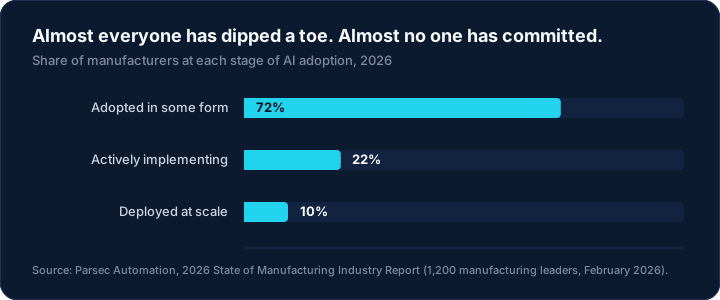
Translation: almost everyone has dipped a toe. Almost no one has committed.
The reason most give for staying cautious is straightforward. High implementation cost is the single most-cited barrier, named by 40% of manufacturers, ahead of data security (39%) and integration difficulty (38%). For a company under 100 employees, that hesitation is rational. Nobody wants to spend $25K or more finding out a tool does not fit how the sales process or the back office actually works.
A note on whose numbers these are. The surveys below cover manufacturers of every size, not just small shops — and that is exactly why they are worth your attention. The companies in this data have dedicated IT staff, capital budgets, and consultants on retainer. They are the ones showing no return. If throwing resources at the problem were the answer, it would already be working for them. So when someone tells a 40-person shop that it is falling behind, ask behind what — because the companies supposedly out in front are not converting it into revenue either.
The other trap: adopting for the wrong reason
Here is the part that gets left out of most "don't fall behind" articles.
A recent Forbes analysis of Grant Thornton's 2026 AI Impact Survey found something uncomfortable about the manufacturers who did move fast. They were adopting AI aggressively, especially in operations — and of the 100 manufacturing leaders surveyed, not one reported a significant revenue increase as a result. Not one reported significant cost savings either. Not slow gains. None. In other sectors, 12% reported each.
The reporting traced this back to motive. Nearly half of manufacturers — 45% — said competitive pressure was the main driver of their AI adoption. Not a bottleneck they had costed out. Not a quote turnaround time or a conversion number they were trying to move. Just the general anxiety that a competitor was ahead of them.
That is an expensive way to buy software.
Anxiety is not a business case.
It shows up downstream, too. Nearly half of manufacturers (48%) are still stuck in the pilot phase, against 34% across industries, and only 7% have tested a plan for what to do when an AI system fails — the lowest of any sector. That is the signature of buying first and finding the use case later.
So what actually costs you money
It is also worth noticing where all that money went. Operations is where 62% of manufacturers said they most want more AI — the plant floor, quality, maintenance. Which means the commercial side of the business, where a quote either gets followed up or does not, has been largely left alone. That is a strange place to leave unwatched, because it is where the revenue actually closes.
Lagging costs you something real, but it is rarely the dramatic thing people imagine. It is not that a competitor has a flashier chatbot.
It is smaller and more specific than that. It is the quote that goes quiet for two weeks with nobody watching. It is the visitor who lands on your site with a real question at 9pm and leaves because there was no fast way to get an answer. It is the RFQ that sat in an inbox over a long weekend while a faster supplier answered first.
Multiply any one of those by a year, and the number is bigger than most CEOs expect — and bigger than the cost of the tool that would have caught it. That is what a revenue leak looks like in practice: money you already earned, lost to a process gap rather than to a competitor.
The fix is not "adopt AI." It is narrower than that.
The one-sentence test: before you evaluate anything, name the specific, costed bottleneck you are trying to close — in one sentence, with a number in it. "Quotes over $25k sit an average of 9 days before first follow-up, and we lose roughly a third of them." If you cannot write that sentence, you are not ready to buy. You are ready to go find the bottleneck.
That sentence is also the best vendor filter you will ever use. Hand it to anyone selling you AI. If they cannot tell you how their tool moves that number, and how you would measure it in 90 days, you have your answer.
The real question
Not "are we behind."
Ask instead: where, specifically, are we losing money right now, quietly, in a way we have not measured?
That answer is different for every company. But it is the only one worth acting on.
Pete Van Schaack is the founder of Liquid Technology Solutions, which builds custom AI sales agents, quoting tools for manufacturers and job shops, and B2B conversion systems for companies that would rather fix a costed bottleneck than buy a category. Reach him at peter@liquid-crm.com.
Sources
- https://www.forbes.com/sites/robertszczerba/2026/07/09/manufacturers-rushed-into-ai-the-returns-arent-showing-up/
- https://finance.yahoo.com/technology/ai/articles/parsec-survey-72-manufacturers-adopted-130000089.html
- https://businesswire.com/news/home/20260716268827/en/Parsec-Survey-72-of-Manufacturers-Have-Adopted-AI-but-Only-10-Have-Done-So-at-Scale
Ready to put this to work?
Liquid Technology Solutions builds custom AI sales agents and runs CRM implementations and automation for B2B teams.
Book a Consultation